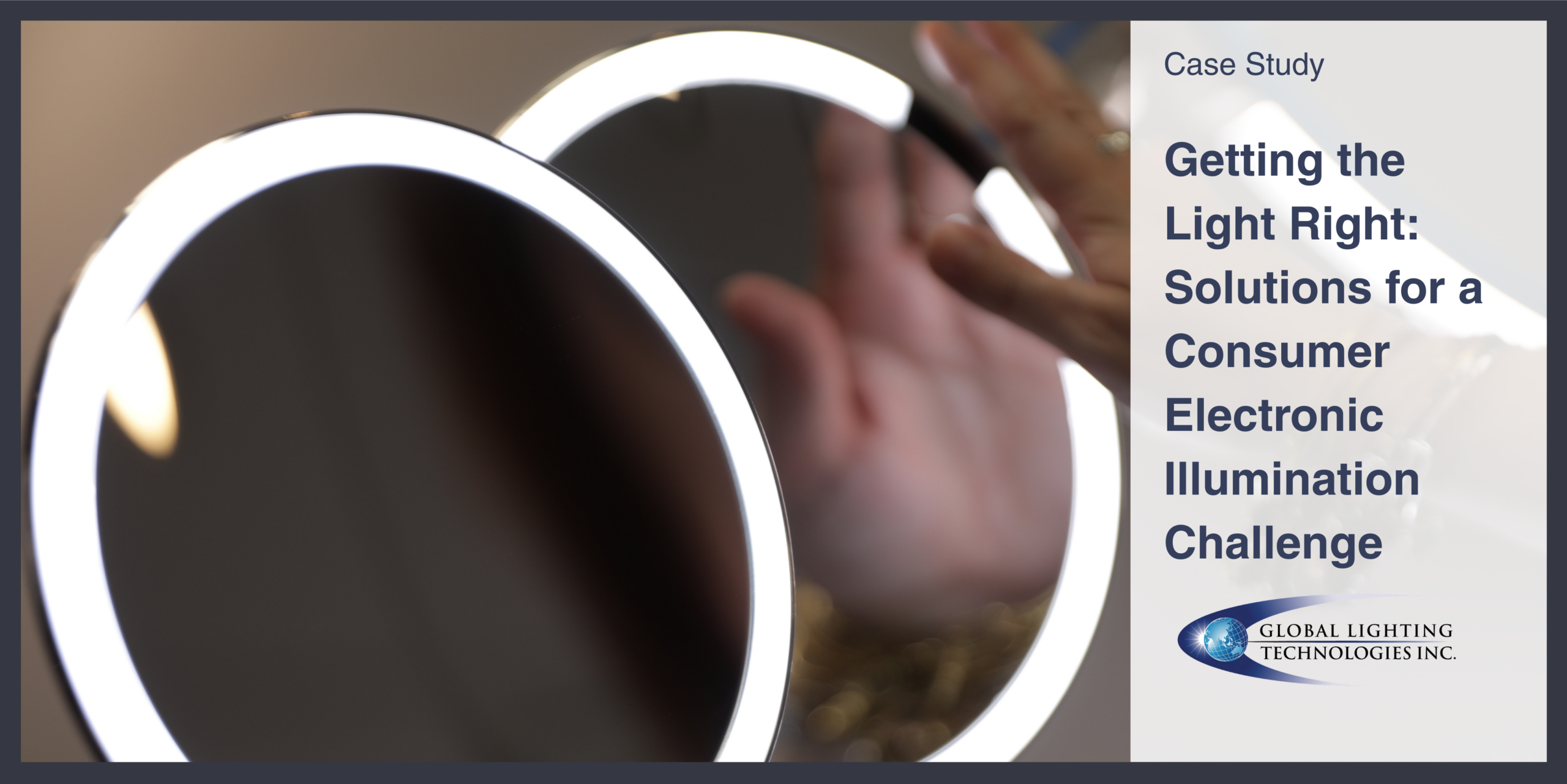
A leading manufacturer of bath, home, and beauty tools needed to illuminate their mirrors in a way that actually worked for makeup application. When their current illumination solution didn’t hit the mark and could have blocked product launch and affected product quality, they came to our team.
See how the Global Lighting Technologies team created an efficient and beautiful solution with a custom consumer electronic light guide and global partnership.
The Challenge
The customer’s beauty mirrors required precise, flattering illumination. Brightness, uniformity, and color temperature all had to be just right. Too harsh, too dim, or off in tone, and the mirror becomes a frustration rather than a tool. Getting this right for makeup application is a real optical engineering problem, and affected both the quality of the mirrors and the end-user experience.
The customer also operates with consistently tight deadlines and demanding optical performance targets. We knew a miss on any of these targets could delay their product launch and result in a lower-quality product reaching consumers. There was no margin for slow iteration, so we jumped right in.
The Solution
We developed a custom consumer electronic light guide solution built around micro-lens structures and wave features, refined through many optical design iterations. The result is a consumer electronic light guide that uniformly illuminates a 10-inch ring light using only two LEDs! This kept the design clean and manufacturable.
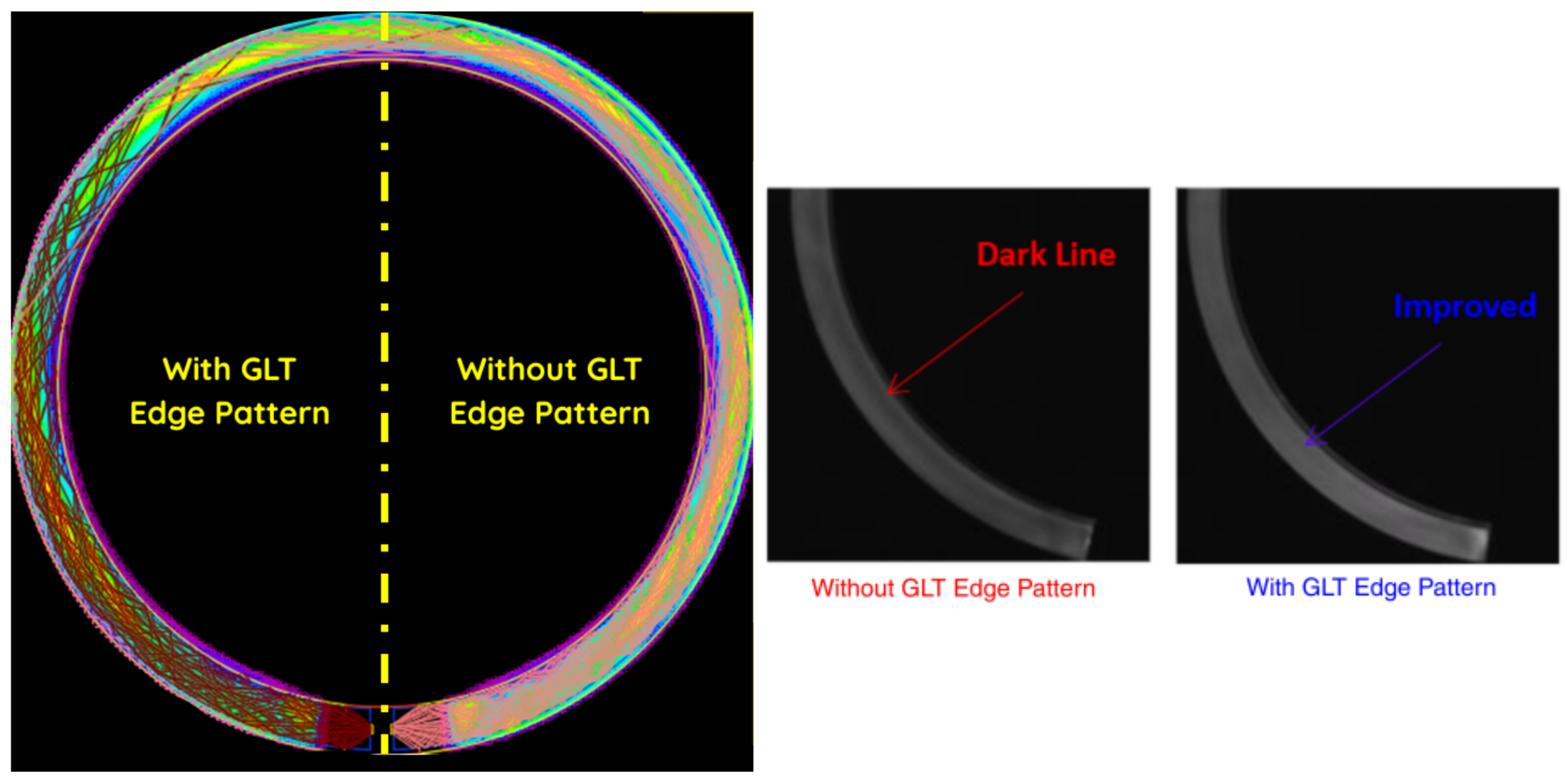
Identifying the right light guide materials was a significant part of the work. Material selection directly affects color temperature output, and the customer’s specifications required careful evaluation alongside the optical design itself.
The result is a consumer electronic light guide that uniformly illuminates a 10-inch ring light using only two LEDs!
All of our teams participated in this program. It was a true team effort among engineering, optics, manufacturing, and quality, all of whom had active roles across design, prototyping, and production.
The Approach
At GLT, we thrive in close collaboration with our customers, and this was no different. We worked directly with the customer’s engineering team and project manager from the start. The focus was on understanding timelines, optical testing fixture requirements, design constraints, and performance targets before any design work began. Regular communication by phone and email kept both teams aligned on project status and shipment schedules.
Optical simulations and design for manufacturability (DFM) feedback were central to the process. These tools allowed us to catch issues early and propose design changes before they became production problems. When design or timeline challenges came up, both teams worked through them together; we even expedited deliveries when needed.
The Impact
I’m proud that we knocked this project out of the park. The optical performance of the delivered consumer electronic light guide solution exceeds the customer’s original expectations. The performance of our light guide allows them to increase the brightness by using higher power LEDs while maintaining uniformity.
The relationship between the customer and us has grown substantially. We are now closely involved in the customer’s full module design process, because the broader design directly affects optical performance. The customer recognizes this connection and brings us in when we’re needed.
Most recently, our team utilized dual shot injection molding to combine the sensor window and diffuser for the customer’s sensor mirrors, a clear example of the partnership evolving into more complex, integrated work.
Lessons for the Industry
This program produced concrete best practices for ring light illumination using optical microstructures, wave features, and draft angles. I believe that lessons learned here will apply to many other consumer electronic light guide projects!
Our biggest piece of advice to product teams working through complex lighting challenges is to pay attention early to material selection, sharp corners, inconsistent wall thickness, LED placement, and coupling edge design. These are the areas where problems typically originate and where early decisions have the biggest downstream impact.
For teams evaluating custom lighting or optical partners, the most important thing is to thoroughly understand how a potential partner manufactures and what optical technologies they actually have available.
Unconventional approaches, including non-standard materials, advanced manufacturing methods like dual shot injection molding, and novel optical technology, may be exactly what a design requires. An open conversation with a potential partner may be all it takes! A partner who can execute those approaches, and communicate clearly throughout, is worth finding early.
If you think your product could benefit from a custom consumer electronic light guide, I’d love to start the conversation. Connect with our team here.